

If you’ve ever snapped a tyre lever halfway through a tube change, you’ll know how frustrating tight tyres can be.
Modern road and gravel wheels, tubeless-ready rims and stiffer tyre beads have made tyre changes harder than they used to be. The result is levers bending, snapping or slipping when you need them most.
So what actually works?
This guide explains what to look for in tyre levers for tight tyres, which types to avoid and how to choose something that will hold up under pressure.
Why tight tyres cause problems
Tighter tyres are now standard across road, gravel and MTB setups.
They’re designed that way for:
- Better tyre retention
- Improved tubeless compatibility
- Safer high-pressure riding
The downside is leverage.
When you’re removing a tight tyre, most of the force is concentrated at the tip of the lever. If the material flexes or fatigues, it fails — usually mid-job.
That’s why material matters more than most riders think.
The main types of bike tyre levers
Cheap plastic tyre levers
Pros
- Lightweight
- Easy to find
- Low cost
Cons
- Flex under load
- Prone to snapping
- Unreliable on tight tyres
Fine for occasional use, but not something you want to rely on.
Metal tyre levers
Pros
- Very strong
- Rarely break
Cons
- Can damage alloy or carbon rims
- Scratch rim edges or spoke beds
- Not ideal for modern wheelsets
They solve the strength problem, but introduce risk.
Reinforced polymer tyre levers
This is where most riders find the balance.
Pros
- Much stronger than standard plastic
- Stiffer under load
- Safe to use on carbon rims
- Lightweight and easy to carry
The key is using a material that can handle force without damaging the wheel.
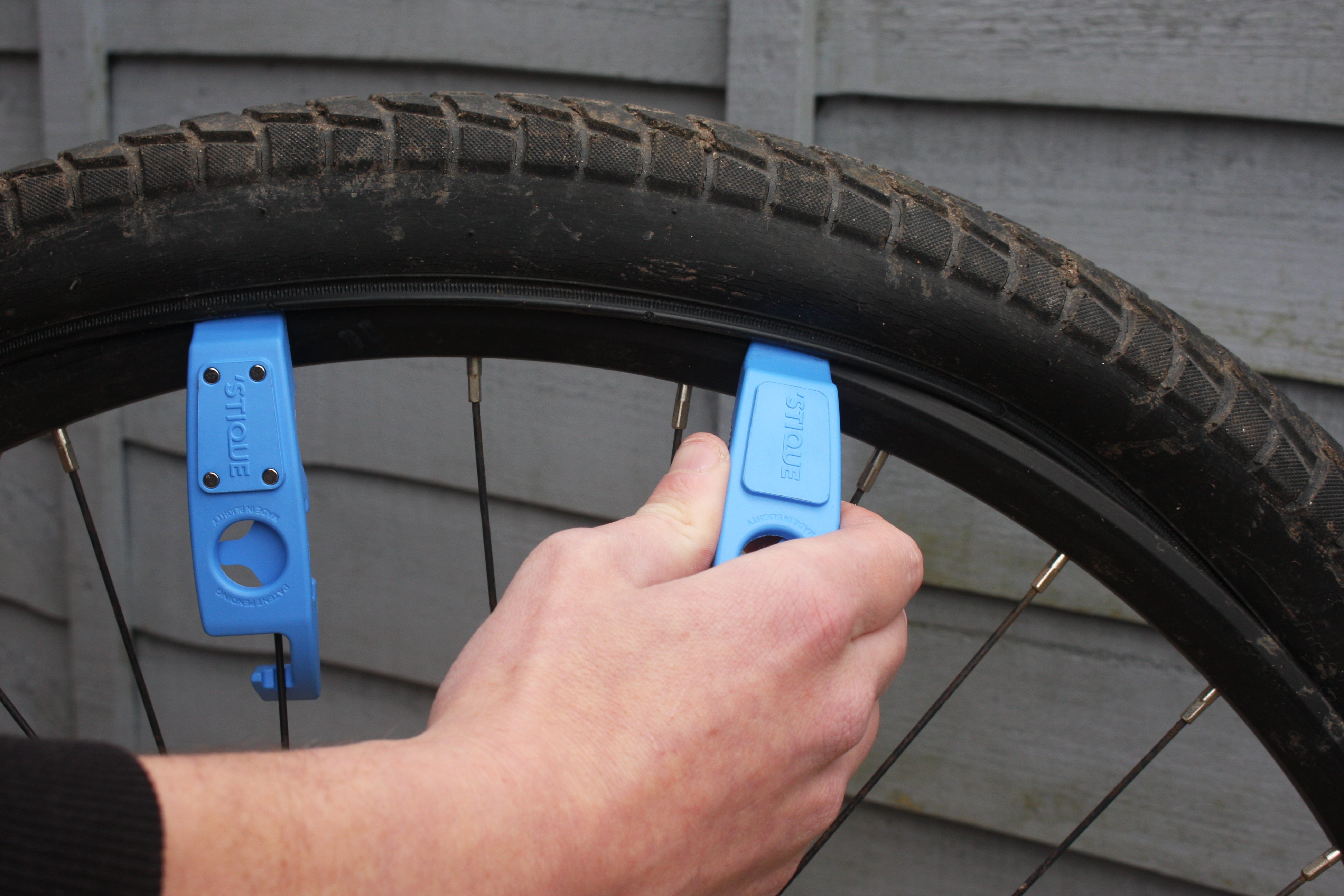
What to look for in tyre levers for tight tyres
If you regularly struggle with tight fits, these details matter:
High-strength material
Look for engineering-grade or reinforced polymers rather than basic plastics.
Stiff lever design
Less flex means more controlled force when lifting the bead.
Smooth, carbon-safe edges
Important for protecting modern rims.
Secure hook or profile
Helps keep the lever in place under pressure.
Compact carry
Simple, quiet tools are easier to keep with you on every ride.
Do stronger tyre levers damage rims?
Not necessarily.
Damage usually comes from:
- Sharp edges
- Metal tools
- Poor technique
A well-designed polymer lever can be both strong and safe to use on carbon rims.
Best tyre levers for carbon rims
Carbon rims are where lever choice matters most. Metal levers can nick the rim bed or scratch the sidewall, and that kind of damage isn't always just cosmetic. For carbon, you want smooth, rounded edges and enough stiffness to lift a tight bead without digging in. A reinforced polymer lever like the ML14, or the lighter ML14CF, is built for exactly this, strong enough for a stubborn tyre and safe against the rim. If you prefer a metal-cored option, choose one with a nylon rim shield rather than a bare alloy blade.
Tyre levers that work on tight tyres
For tight modern tyres, simple, well-designed tools tend to outperform bulky or overly complex options.
Stique ML14 – dependable everyday option
The Stique ML14 Bike Tyre Levers are designed for riders who want something reliable without overthinking it.
- Engineering-grade polymer construction
- Stiff enough for tight road and MTB tyres
- Safe for carbon rims
- Lightweight and easy to carry
- Far stronger than standard plastic levers
- Covered by the Stique lifetime guarantee
They’re a solid choice for everyday riding, commuting and general use.

Stique ML14CF – lighter, premium option
The Stique ML14CF Carbon-Fibre Tyre Levers use carbon-fibre injected polymer for a lighter feel while maintaining strength.
- Built for frequent use
- Designed for tight tyre setups
- Smooth edges for rim protection
- Compact and easy to pack
- Covered by the Stique lifetime guarantee
Best suited for riders who want a lighter setup without sacrificing reliability.

How the alternatives compare
The ML14 and ML14CF are what we make and stand behind, but they aren't the only levers worth knowing about. Here's an honest look at other options UK riders rate, and where each one fits.
Muc-Off Rim Stix. Strong, with an integrated valve core remover, and shaped to avoid scratching rims. A reliable everyday choice.
Pedro's Tyre Levers. A long-standing favourite. Robust, ergonomic and brightly coloured, so they're easy to find in the bottom of a bag.
Schwalbe Tyre Levers. A wide profile that works well on tight tyre and rim combinations, with a clip to hold them on a spoke while you work.
Lezyne Power Lever XL. Longer than most for extra leverage, which helps on stubborn beads, and built to take heavy use.
Silca Tyre Lever Premio Set. A forged alloy blade wrapped in a reinforced nylon rim shield, so you get metal strength without the metal-on-carbon risk. Premium, and priced like it.
All decent tools. Where the ML14 and ML14CF earn their place is the combination of UK manufacturing, carbon-safe polymer and a lifetime guarantee, so if one ever does fail, we replace it.
Are expensive tyre levers worth it?
Not always — but reliable ones are.
When a cheap lever fails:
- You lose time
- You risk damaging your rim
- You may not be able to finish the job
A stronger lever isn’t about spending more. It’s about avoiding the problem entirely.
Final thoughts
For tight tyres, the best bike tyre levers are:
- Strong enough not to flex
- Safe for modern rims
- Simple and reliable to use
Avoid ultra-cheap plastic tools and aggressive metal levers. Look for something that balances strength and control.
If you’ve struggled with tight tyres before, upgrading your tyre levers is one of the simplest ways to make roadside repairs easier.
And because every Stique lever is covered by a lifetime guarantee, buying one is a decision you only make once.
Want those same strong levers built into a full multitool? See our guide to the best bike multitool.